This article is a first in a Four-part series on the Agentic Enterprise Revolution by Dr. Lamia Youseff, CEO of Jazz Computing. This article is also cross-published on Linkedin. Future Articles include Part 2: why AI transformation keeps failing. Part 3: The Management Science and Frameworks For The Agentic Enterprise Era Part 4: The Agentic Enterprise Transformation Playbook.
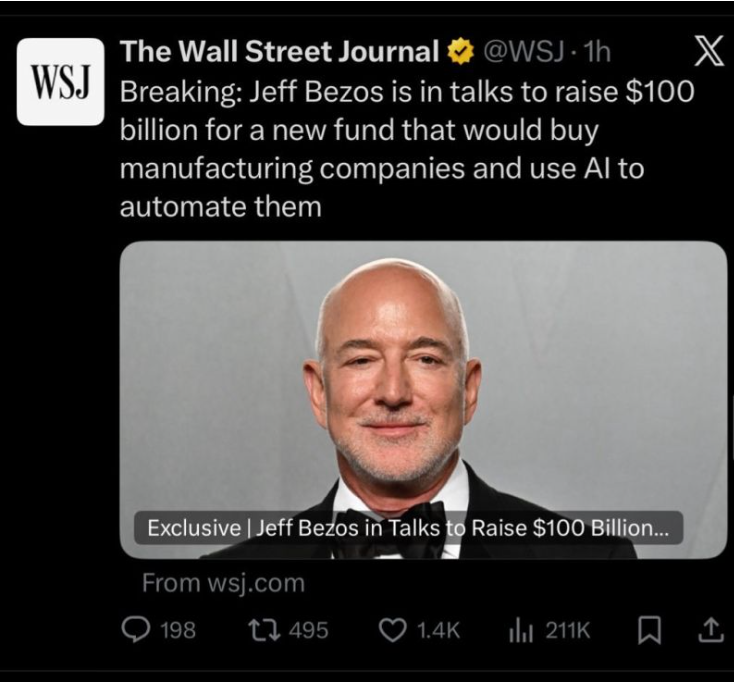
Jeff Bezos is reportedly raising $100 billion, not to build a better AI model, buy more GPUs or compete with Claude Code, or ChatGPT, but to acquire manufacturing companies and fundamentally transform how they operate using AI.
Let that sit.
This is $100 billion to flip how companies work from the inside out. Not a bet on AI. A bet on organizations. That tells you everything about where this is actually headed
On the other hand, open any tech or business publication right now and it’s the same conversation on repeat: compute, benchmarks, Nvidia earnings, frontier labs, Claude versus ChatGPT vs Replit. How to automate business workflows with agents. Who has the best reasoning. Who offers the cheapest inference. Who provides the largest context window.
Nobody — and I mean almost nobody — is asking the question that actually matters.
What happens to the organizations where we spend 80% of our waking lives when intelligence becomes programmable? What happens to the schools where our kids spend 80% of their childhood?
I’ve been thinking about this question since 2022, and I can tell you: we are not ready for what’s coming.
I’ve seen this movie before
At Microsoft , I worked with world-class architects on the Customer Advisory Team—we called it CAT. Part of our job was to work with Fortune 500 companies and SMBs, build their technology roadmaps, understand their use cases, and design their technical architectures. We were “forward-deployed engineers” before anyone coined the term.
The hardest part was never the technology. It was always change management. Every single time.
At Meta, I helped scale FBLearner, one of the largest machine learning platforms in the world at the time. At Apple, I led a 150-person AI engineering organization. I watched the most technically sophisticated companies on earth struggle for years—not to build AI products, but to integrate AI into how they actually operated as organizations.
Here’s a story I can’t get out of my head. While I was building the AI platform at Facebook, a product leader from a completely different product group came to me and asked if I could help him “sprinkle some AI” on his product. Just, you know, make it AI-enabled.
Let's sprinkle some AI on the product!
That phrase has lived rent-free in my head ever since because it captures exactly what’s still happening today, everywhere, at every level. The distance between AI as a capability and AI as an organizational transformation is enormous—and most leaders can’t see it yet.
Sprinkling AI on your company is not a strategy. It’s a garnish.
Three waves — and the third one is a different animal
The first wave of AI improved productivity. Better algorithms, faster processing, smarter narrow-task automation. Fine. Useful. Incremental.
The second wave gave us copilots. AI sitting beside a human — suggesting, drafting, editing, accelerating. GitHub Copilot. ChatGPT as a thinking partner. Real gains for individual productivity. But here’s the thing: the organization doesn’t change. Same reporting lines. Same meetings. Same middle management doing the same middle management things.
The third wave is not a better version of the first two. It’s a phase change.
The third wave is the Agentic Enterprise. Autonomous AI systems performing the majority of cognitive workflows. Agents that don’t just assist humans but coordinate with them, report to them, and / this is the part nobody wants to say out loud / in some cases, manage work that humans used to own.
This isn’t a feature upgrade. This is a rewiring of how companies work.
Before the factory had a name
When mechanized production arrived in the early days of the industrial revolution, we didn't just get new machines. We had to invent entirely new ways of organizing people around them. The factory. The assembly line. Mass production. Shift work. Quality control. Labor unions. Industrial capitalism and finance. None of these concepts existed before the machines that demanded them. The resistance wasn't to the machines themselves; it was that nobody knew how to restructure human work around them until someone defined the concepts and the organizations.
We are at exactly that moment again. Cognitive machinery is entering the heart of how organizations operate. And we're trying to manage it with the vocabulary and organizational designs of the previous era.
The playbook that never left big tech
But here’s what keeps me up at night.
Big tech has been going through this transformation for twenty years. Google was using AI in algorithmic advertising for at least a decade before Sundar Pichai declared it an “AI-first company” in 2016. Ten years of quiet, painful, internal organizational upheaval before they even put a name on what they were doing.
Meta went and is going through it. Apple went and is going through it. Microsoft went and is going through it. Years of restructuring teams, rethinking workflows, failing spectacularly, recovering slowly, building the muscle to actually operate with AI at the center.
Billions in revenue were unlocked. But also: countless failed initiatives. Reorgs that went nowhere. Cultural resistance fought one team, one director, one stubborn VP at a time.
And here’s the part that should genuinely alarm every enterprise leader reading this.
Those lessons stayed inside. All of them.
The technology made its way out — we all have GPT-4, Claude, Gemini, open-source models, the whole stack. But the transformation playbook? The hard-won, expensive, sometimes brutal knowledge about how organizations actually change to operate with AI?
That stayed locked in big tech’s institutional memory.
The world got the tools. It never got the manual.
Two types of companies. That’s it.
In ten years, you will have exactly two types of companies: AI-native and AI-transformed. Everyone else will be gone or going.
AI-native companies are being born right now with fundamentally different economics: small teams, high margins, and speeds incumbents can’t match. AI isn’t something they adopted, it’s the foundation they were built on. They launch with what the rest of the market will spend years trying to retrofit.
AI-transformed companies are the incumbents that actually made it through. They restructured. They rethought how humans and machines work together. They survived the hardest organizational change since the internet — maybe harder, because this one touches every knowledge worker in the building.
Everyone else? Think about what happened to companies that missed the digital transformation. Now compress that timeline by half. Maybe more.
This follows the classic adoption curve — early adopters, early majority, late majority, laggards. But here’s the difference: in this cycle, the laggards don’t get a second chance. AI-native competitors move too fast. The window for transformation is narrow and it’s closing.
The pressure is here. The roadmap isn’t.
I talk to SMB founders and Fortune 1000 executives every week. The pattern is always the same.
They have what matters: deep customer relationships, rich data, domain expertise that no startup can replicate overnight. But they also have antiquated systems. Processes that work but are set in stone. IT teams that were built for a different era. And enormous pressure from boards who’ve read the same headlines and want to know: what’s our AI strategy?
The honest answer, the one nobody wants to give their board: the roadmap for this transformation isn’t fully built yet. The ROI frameworks for agentic transformation are nascent. True talent is rare and being fought over by everyone. The process has more unknowns than knowns.
Here’s what’s counterintuitive, though. Companies with small IT teams might actually have an advantage. They don’t have to retrain or lay off hundreds of engineers. They don’t have the organizational inertia of big tech. The change management challenge is still real but the surface area is smaller and less risky.
I’ve been predicting this enterprise tsunami since 2022. I gave a talk on exactly this at the Arize AI conference in 2023, then Bank of America Merrill Lynch Global Transformation Summit in 2024 and Bank of America Asia summit and LEAP in 2025. I keep saying the AI enterprise tsunami is coming. Everything I said then is playing out now, faster than I expected.
This is not a technology problem
I need every executive reading this to hear this clearly.
The Agentic Enterprise is not a technology story. It never was. It’s a story about the future of work — how humans and AI agents will work together, manage each other, collaborate in ways we don’t have language for yet. It’s a story about the future of organizations; how do you structure a company when knowledge work becomes automatable?
We have an entire industry building better AI. We have almost nobody building better organizations around AI. Nobody defining the architecture of the firm in an age where intelligence is no longer exclusively human. The modern company is evolving from a human organization supported by software into an Agents-mediated organization directed by humans. That sentence should be on every board deck in the world right now. It isn’t.
The question is no longer whether this transformation is coming. It’s here. The question is whether anyone has the playbook for how to get through it — and whether you’ll have access to it before the window closes.
I’m building that playbook and beta testing it with several partners. And in the next piece, I’ll tell you why 75% of transformations fail, why AI agents make the problem exponentially harder, and what twenty years inside big tech taught me about the one obstacle that no amount of compute can solve.